By Dr. Cong Liu
*The second of two pieces on human-centered AI. Notes from the 7th World Conference on Remedies to Racial and Ethnic Economic Inequality, where I argued that generative AI can broaden access to expression without ever removing the person from the center of it.*
Mental wellness is not usually discussed as an economic question. Yet at the 7th World Conference on Remedies to Racial and Ethnic Economic Inequality, held at the University of Minnesota’s Humphrey School this August, it belonged squarely within a track on the future of prosperity and new economic models. The reasoning is simple. When some communities cannot access the language, the services or the cultural safety needed to care for their own well-being, that gap is not only a health problem. It is a form of inequality, and it carries an economic cost.
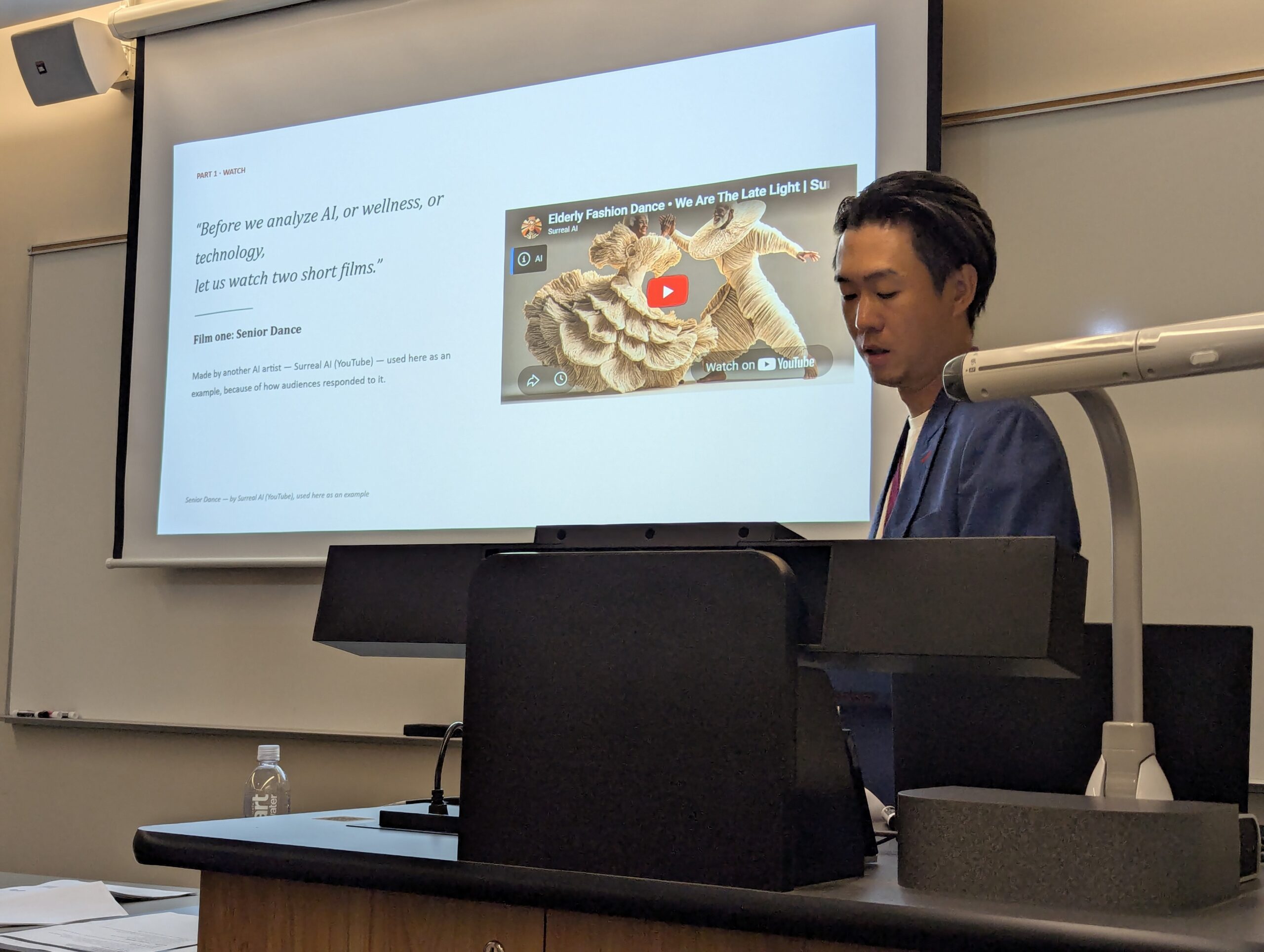
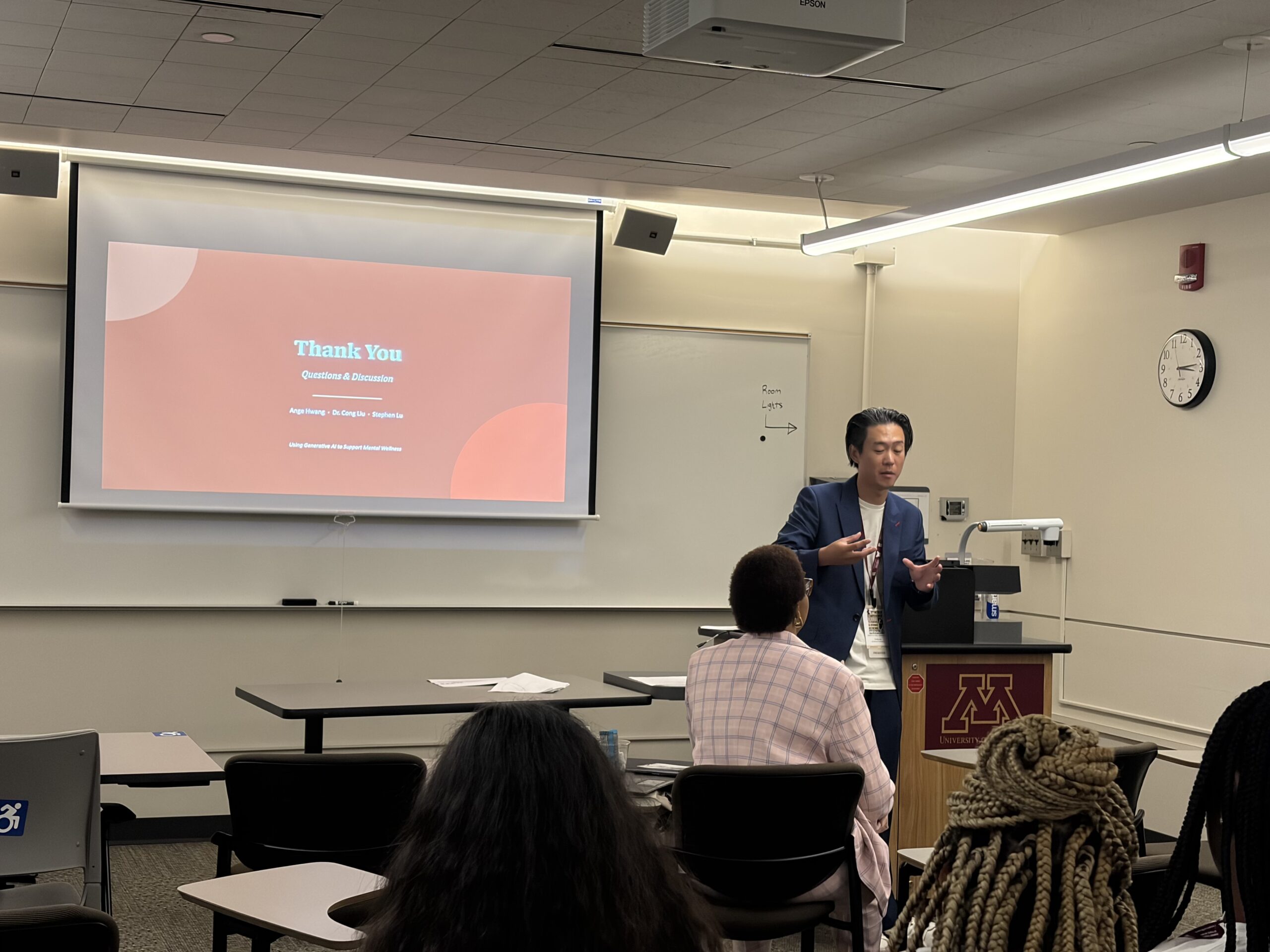 Teamed Up with Asian Media Access, I presented at the 7th World Conference, drawing on works developed by AMA from generative AI and how it successfully related to the mental wellness. In an earlier piece I drew a line between having access to a tool and having agency through it: being able to open an AI application is not the same as being able to turn it toward something you actually need. The conference was where that distinction met its hardest test, because the stakes were no longer only creative. My central claim was not that AI can heal people. It was narrower and, I think, more durable: used well, AI can be a new kind of bridge—one that widens access to creative and emotional expression for people the existing system does not serve well, while leaving the person who crosses it firmly in the lead.
An unequal starting line
Support for mental wellness is not distributed evenly, and the reasons are not only financial.
 In many Asian and immigrant communities, the barriers are cultural. There is stigma around naming a struggle out loud. There are language gaps that make existing resources feel like they were built for someone else. There is the quiet pressure of the “model minority” expectation, which teaches people that showing vulnerability is a failure rather than a normal part of being human. A person can live within reach of services and still find no way in.
Cultural difference, in other words, is itself part of the inequality. And a tool that ignores that difference—that assumes one language, one idiom of distress, one way of asking for help—will reproduce the gap rather than close it.
This is where I see a genuine role for generative AI. Not as a replacement for care, but as a way to lower the distance between an inner experience and a form that can be shared.
What the technology actually did
The clearest example in my own work is a set of multilingual public-health pieces on extreme-heat safety, which I produced using AI-assisted music and visual media. The goal was not just an attractive video. It was for the information to be understood, remembered and acted on by people who might never read a long written warning—and to reach them in more than one language.
Making that quickly, and in several cultural registers at once, would have been far harder without these tools. The same was true in the community media workshops I have led, where participants with no technical background could begin from something they already had—a memory, a melody, a story—and carry it into an image or a short film.
That is the appeal of the technology, and it is real. But it is only half of what I wanted the room to take away.
The part the machine does not do
Generation is fast. Meaning still requires judgment.
A system can produce ten versions of a scene, ten melodies, ten ways to say the same sentence in a different language. Abundance is not the same as a finished work. Someone still has to decide what the piece is trying to communicate, which outputs serve that purpose and which are merely novel. In the extreme-heat pieces, a generated image that showed a symptom incorrectly, or a character who recovered too quickly, would not have been a stylistic flaw. It would have been a false message about a dangerous condition. No model could take responsibility for that. Human review, cultural feedback and repeated revision could.
This is why I describe AI in my work as a bridge rather than an author. The idea does not come from the machine. In the workshops, the participants already had something they wanted to say; the technology gave it a form that could be shared. It did not supply the will to speak. It extended the reach of a will that was already there.
Keeping the person in the lead
I was careful at the conference to name the limits as clearly as the possibilities, because the two are connected.
AI is not a therapist. It should not stand in for diagnosis, professional treatment or human care. A system can produce emotionally convincing language without understanding a single thing about the person receiving it, and that fluency can create a false sense of authority—or, worse, a substitute relationship. When people begin to treat a model as a companion rather than a tool, the technology stops widening the door and starts standing in the doorway.
Guarding against that is not a constraint on the human-centered approach. It is the human-centered approach. The point of keeping AI in the role of assistant, bridge and instrument is precisely to keep the person—their judgment, their voice, their choices—in the position of authorship. Human agency is not something the technology threatens by accident and we defend after the fact. It is the thing the whole design is meant to protect.
A more shared kind of prosperity
If there is an economic argument in all of this, it is not about efficiency. It is about who gets to participate.
A human-centered model of AI would widen the circle of people able to express, create and be understood—especially those currently outside it—without flattening the cultural differences that make their expression theirs. It would treat a community not as an audience for tools designed elsewhere, but as authors of their own stories, using new instruments on their own terms.
That is the version of “shared prosperity” I care about. Not a future in which machines express more on our behalf, but one in which more people gain the ability to express what was already inside them.
The technology can widen the door. It cannot decide who can walk through it, or choose where to go once inside. That decision was always ours, and keeping it that way is not nostalgia. It is the whole point.