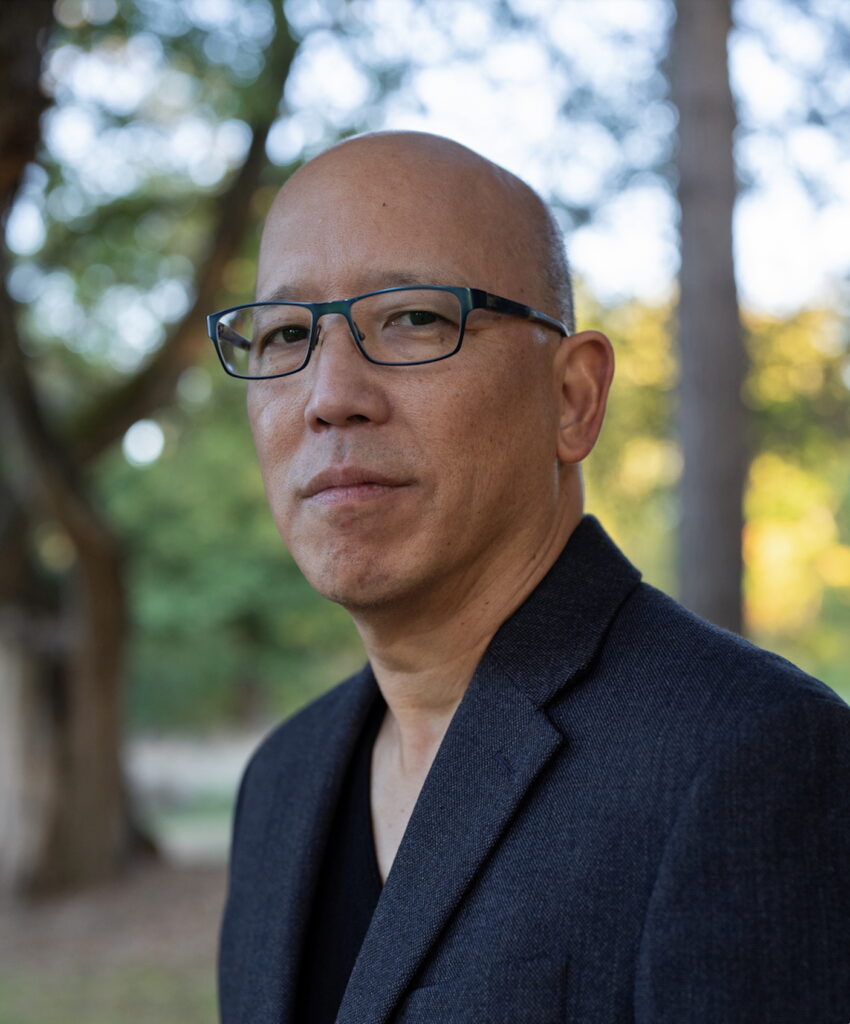
By Scott Kurashige, the President of the James and Grace Lee Boggs Foundation
Preface: In this powerful guest editorial, Scott Kurashige reflects on how the persistent reality of anti-Asian violence in the United States has shaped not only his scholarship, but his lifelong commitment to activism. Drawing on more than three decades of research, teaching, personal experience, and community engagement, Kurashige situates recent surges in anti-Asian hate—especially in the wake of the Atlanta spa shootings—within a much longer and deeply embedded history of racialized violence, exclusion, and political scapegoating.
 As President of the James and Grace Lee Boggs Foundation and coauthor with Grace Lee Boggs of The Next American Revolution, Kurashige brings both intellectual rigor and movement-based insight to his work. His new book, American Peril, challenges readers to confront the systemic roots of anti-Asian racism while pointing toward a future grounded in solidarity, grassroots organizing, and multiracial democracy. On May 17, 2026, KurasigeI will be coming to the Twin Cities discuss his new book, American Peril: The Violent History of Anti-Asian Racism, at the invitation of the Minnesota Historical Society and East Side Freedom Library.
How the Problem of Anti-Asian Violence Spawned My Life in Activism
By Scott Kurashige
My introduction to Asian American activism coincided nearly perfectly with the release of Who Killed Vincent Chin? during my first year of college. I first saw it in a dorm lounge at the University of Pennsylvania sometime in 1989, at which point it was available on VHS cassette. I had recently joined a student activist group, and we decided to do a series of screenings, including segments from the Civil Rights Movement series Eyes on the Prize, to promote antiracist awareness. We only had access to a 19-inch TV, not a big screen or projector, which was adequate since there could not have been more than ten of us in the room. This was the late 1980s: while students had won South African divestment prior to my arrival, progressive activism was not trending.
Penn was most popular for its Wharton Business School, where Donald Trump attended. According to exit polls, it was the only campus where a majority of students voted for George Bush in the 1988 presidential election. Fraternity houses, which were filled almost entirely with white men, lined both sides of Locust Walk, holding an exclusive privilege in the center of campus. (Everyone else lived around the outer edges.) The frat brothers would wiz footballs close to your face as you walked by, and on sunny days, some would sit in beach chairs, ogle women, and hold up numerical ratings. A few blocks from campus, however, the neighborhoods were predominantly Black and poor. This was jarring to see. Though the part of Los Angeles I grew up in was anything but a model of racial equality, it was diverse and integrated in ways that made West Philadelphia’s race and class divides stark by comparison.
As I began to become more conscious of societal problems, I took the usual path to politics and volunteered for the Michael Dukakis campaign. Though I was not a leader and just went wherever I was told to go, canvassing took me off campus and opened me up to new experiences. For instance, a photo of menext to Kitty Dukakis—at least the denim jacket I was wearing—made the Philadelphia Inquirer. But the experiences out of the spotlight were more formative. Etched in my memory is an exchange with a young white woman, a passenger in a car that drove by our group as we marched through South Philadelphia holding “Dukakis-Bentsen” signs and encouraged passersby to vote. She went out of her way to roll down the window and yell, “I’m voting for Bush because he helps white people!” A naïve spectator at first, I yelled back, “Rich white people!” The car was out of earshot, but my fellow canvassers appreciated the gesture. This was my introduction to South Philadelphia’s history of racial conflict and the broader problem of white, blue-collar racism that is central to Who Killed Vincent Chin?,
Our group, the Progressive Student Alliance, was racially mixed but mostly white. I had checked out one of the Asian American student groups with my Chinese American roommate, Lawrence, but they seemed didn’t seem to be much more than social cliques. Later on, a small group of us founded the Asian American Student Alliance and pushed for ethnic studies courses. At the time, however, the university did not offer a single class in Asian American Studies, and I knew next to nothing about Asian American history aside from family lore. As such, I had no idea what to expect from the film. It had been nominated for an Academy Award, so that suggested to me it was worth viewing. My most visceral memory is that I began tearing up midway through the screening, then crying profusely with tears streaming down my checks. This continued for the remainder of the film. It was not just the tragedy of Chin’s death that overwhelmed me; it was the way the film brought the pieces of the story together in a way I had never seen before. Most of all, I was inspired by the protests, activism, and movement building. I had recently decided to become an activist, but I did not have immediate Asian American organizations or campaigns to use as role models.
The film’s theme of breaking the silence resonated because like many Asian Americans, I had grown up enduring racist taunts, microaggressions, and sometimes outright bullying. And though I had Asian American friends who were much tougher than I was, in most instances I felt powerless. That is why I was struck by the comments of an elderly Chinese American woman who appears at the film’s halfway point, signaling the narrative shift from oppression to community activism: “From the very beginning of our background, our parents have always taught us to be very low-key and not to participate in activities or even in in politics. So the Asian Americans have been always in the background and reluctant to speak out.” While not named in the film, I learned after meeting her in Detroit that she was a longtime Chinese American community figure named Mable Lim, the daughter of a Chinese immigrant laundryman. Underlying her statement were memories of countless encounters with racist white folk. These are the kinds of insights captured by author Paula Yoo in her book, From a Whisper to a Scream.
My own memories began racing through my head during that first viewing of Who Killed Vincent Chin? In sixth grade, for no reason whatsoever, a white boy came up to me and kicked me in the groin. I will never forget this kid’s name because there’s an entertainer who became famous in the nineties with the same name. We had been more or less friends, so I did not have my guard up. He didn’t want to fight—just thought that was a fun thing to do and walked away. I don’t recall doing more than mouthing some words of disbelief. If I had been bigger and better at fighting, I might have done something more. While not an everyday experience, this was the kind of thing that just seemed to be a normal part of life. I never even considered reporting the incident to a teacher or principal. The school leadership gave us no sense that they would do anything about racism or bullying, so retaliation seemed the most likely outcome.
The next year, before the opening bell rang, I was going to my locker with my Japanese American friend Dean, whose mom drove us to school. Another kid came out of the blue and called us “chinks.” Again, this was entirely unprovoked. He did not have a famous name, so I don’t know if I ever knew who he was. Dean clapped back immediately. “You’re so stupid. Chinks are Chinese.” The guy walked off, not wanting to push it further. I think I was relieved there was no escalation. To be honest, however, I most recall being taken aback by Dean’s comments. I had been called a “chink” and heard other Asian Americans called that slur so many times that I never realized until that moment it was a specifically anti-Chinese epithet. And that sort of makes sense because in practice, it is an all-purpose anti-Asian slur—just as Japan-bashing can strike at Asian Americans who are not ethnically Japanese.
Ironically, this incident happened almost the exact same time that Vincent Chin, as a Chinese American, was scapegoated for the layoffs attributed to Japanese automakers. Tragically, it is racism that so often provides the glue that bonds Asians from different ethnic backgrounds to come together. The scholar Yen Le Espiritu calls this “reactive solidarity.” But when we come together, we can also create something new: a new sense of identity; a new culture; a new social movement—not just for ourselves but to change the world around us, as well. At the turn of the twentieth century, I moved to Detroit and was blessed to work closely with Grace Lee Boggs, whose 75 years of activism inspire Asian Americans but also serve as a model of Black-Asian solidarity based on her involvement in the Black Power Movement as a Chinese American and her personal/political relationship with James Boggs, a Black radical activist.
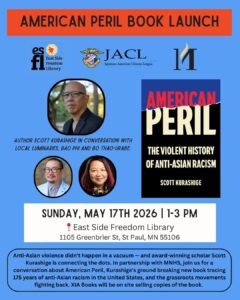 On May 17, I will be coming to the Twin Cities discuss my new book, American Peril: The Violent History of Anti-Asian Racism, at the invitation of the Minnesota Historical Society and East Side Freedom Library. At grave risk to their own safety, Minnesotans have played such a vital role standing up to the terror campaigns of ICE and federal agents. Without this support, all of us—immigrants and US-born—would likely be facing even greater threats to our civil liberties and our communities right now.
I am especially looking forward to conversations with Asian American activists in the Twin Cities, such as those who fought for justice for Fong Lee, a Hmong American teenager who was chased and killed by a Minneapolis police officer in 2006. Around the same time, I worked with Detroit activists to respond to the police killing of a Hmong American teenager, Chonburi Xiong, near Detroit. These cases remind us that we cannot view more and harsher policing as an antidote to anti-Asian violence. Instead, our work must address the problems of state violence and militarism.
As with the case of Vincent Chin, there was no real accountability from the justice system, but there are valuable lessons from that movement. Reminding the public how African Americans regularly turned out to support her, Fong Lee’s mother made a dramatic and moving appearance in support of justice for George Floyd. In doing so, she pointed to the solidarity from below we will need to create a word where we can all live in peace.
Scott Kurashige is the author or co-author of five books, including The Next American Revolution: Sustainable Activism for the Twenty-First Century with Grace Lee Boggs. His newest book, American Peril: The Violent History of Anti-Asian Racism, was released on April 7, 2026.